What happened at COP30? Five Key Takeaways for Carbon Markets, Forest Protection, and Indigenous Governance

COP30 in Belém will go down in history as a “Forest-First COP,” as it represented the first COP to take place in the gateway of the Amazon. It will also be known as the “People’s COP,” because unlike other COPs, climate politics were directly confronted with thousands of people who live the daily reality of protecting the world’s largest rainforest. But while governments debated climate commitments, Indigenous leaders and forest community members were demonstrating what real climate action is already achieving.
This year, Wildlife Works hosted and participated in more than a dozen sessions across Belém. Together with Indigenous partners and allies, we showed how territorial governance, community-led bioeconomies, and integrity in carbon and biodiversity markets can fill the gaps left by global politics.
Below are the five main takeaways from COP30, and how our events and partners brought solutions to life.
1. Indigenous participation was historic, but still sidelined in official negotiations
COP30 saw record-breaking Indigenous attendance, yet this visibility did not always translate into real decision-making power. Protesters rightfully demanded access to negotiation spaces and meaningful influence on policies shaping their territories.
Across multiple Wildlife Works sessions, Indigenous voices weren’t just present, they were leading the discussions. Due to Wildlife Works’ deep, multi-year commitment to knowledge exchange around climate solutions, community members fielded technical questions regarding REDD+ and biodiversity markets.
Yawanawá leadership joined Dr. Monique Vanni and Daiane Tenharin to discuss market-based approaches for conservation, Indigenous governance, and women’s leadership in conservation projects. Daiane explained that, "'It is important for us to have this partnership with Wildlife Works because it brings us into these spaces, allows us to take part in the discussions, and to defend our goal of having a REDD+ project. It is a direct and participatory relationship, something we do not experience in our interactions with the government today. It is a partnership that truly works as a partnership."
Panels like “Territories and Climate and Nature-Based Production” centered community wisdom and territorial governance as the backbone of climate solutions.
The Tembé people used film to share their story of using REDD+ climate finance to reclaim an ancestral road that had been seized by outsiders extracting resources from their territory. Over three days of screenings of their film, Transtembe, and roundtable discussions with Chief Carlos Sérgio Tembé and the Wildlife Works team, participants explored the film’s themes and the territorial protection strategies shaping ongoing conservation work in Alto Rio Guamá territory.

2. For a “forest-first COP” real commitments to protect nature were lacking.
COP30 took place in the Amazon for the first time ever, bringing global climate negotiations directly into the world’s largest rainforest. By the close of COP30, the UNFCCC registry showed 120 updated climate plans, leaving more than 70 still missing. While most countries’ updated Nationally Determined Contributions (NDCs) mention nature, few include actionable plans, leaving the world on a 2.5°C trajectory.
The Global Goal on Adaptation working group introduced the first universal indicators to systematically measure global progress in protecting communities and natural systems from climate change impacts, but the final package lacked transparency and rigor.
Our events demonstrated what on-the-ground practitioners can get done today, despite bureaucratic inaction:
“Making Biodiversity Markets Work for Indigenous Peoples” explored how Indigenous governance can shape the future of nature finance. While some anti-market activists make sweeping claims that all Indigenous communities are against market-based models, Tashka and Laura Yawanawá spoke powerfully about the right of communities to choose their own economic pathways, including market models that they shape, govern, and benefit from directly.
“Business in the Rhythm of the Forest” challenged extractive development models and uplifted community-led entrepreneurship.
The ABEMA Charter for Biodiversity panel offered concrete pathways for subnational biodiversity action.
These conversations showed that successful nature solutions must be designed with communities.

3. United Nations backed Carbon Markets Advanced Towards Being Operational, But Left Major Gaps for Nature
Article 6.4 is designed to provide a UN-backed, internationally recognised carbon-crediting mechanism under the Paris Agreement. If implemented well, it can unlock private finance, channel nature-based mitigation action into developing countries, and help meet globally agreed emission-reduction goals. The Article 6 rule-book had largely been agreed at the previous COP (COP29 in Baku). At COP30, negotiators took concrete steps toward operationalizing Article 6.4, through the “Paris Agreement Crediting Mechanism” (PACM).
Decisions on permanence, reversal risk and all nature methodologies have been pushed at least to 2026, and guidance on jurisdictional REDD+ has slipped down the agenda.
Our technical and policy-focused sessions ensured nature wasn’t left behind:
Our session called “Nesting and Integrity in Forest Carbon” brought together governments, companies, and experts to discuss how jurisdictional programs and projects can align for credibility and scaled impact.
This panel emphasized how project-based REDD+ continues to be the driver of action in the forest conservation space, while the JREDD market slowly builds momentum. Project-based REDD+ will experience a significant leap forward under the Equitable Earth program.
Dr. Monique Vanni, Brazil country director for Wildlife Works, spoke across multiple stages on jurisdictional REDD+, nested baselines, and integrity in nature markets, providing technical direction where negotiations stalled. She reminded us of nesting’s true purpose:
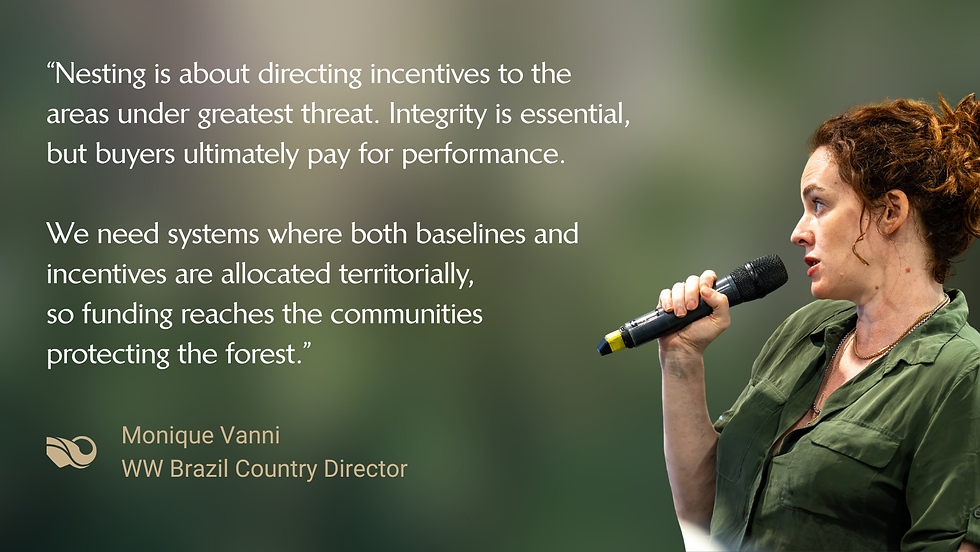
At a moment when Article 6 still risks sidelining nature, our work put community-centered REDD+ at the heart of the conversation.
4. Climate finance for Indigenous lands grew, but accountability is still missing
One of COP30’s strongest outcomes was the renewed $1.8 billion Forest and Land Tenure Pledge, combined with commitments to strengthen 160 million hectares of Indigenous lands. But funding pathways remain unclear: Who receives this money? Will it support the governance systems that actually safeguard the forest?
The Tropical Forest Forever Facility (TFFF) was launched as a Brazil-led initiative to provide payments for preserving tropical forests, though initial funding pledges fell short of its $25 billion goal. The fund attracted approximately $6.6 billion in commitments, including contributions from Norway, Indonesia, and Germany. While hailed by some as an innovative finance mechanism, others, including civil society groups and some nations, raised concerns about the fund's structure, the potential for it to increase debt for some countries, and a lack of clarity on how funds will reach communities.
In our panels, Wildlife Works highlighted how direct finance can strengthen forest community autonomy. Our case studies and panels showed what funding aligned with Indigenous governance looks like.
“Voluntary Carbon Markets as an Accelerator of the Bioeconomy” presented concrete examples of REDD+ revenue fueling local entrepreneurship.
The Transtembé film premiere showcased how the Tembé people used the REDD+ consultation processes they co-designed to rebuild community unity.
Our multiple panels on biodiversity markets highlighted how innovative models like Biodiversity Stewardship Units can be effective by valuing traditional knowledge, respecting local cultures, and centering community leadership.
As Valber Témbe put it, “Projects belong to each territory; they must be specific to each people and to each Indigenous land. Our territory chose to work with the private sector. We want to build autonomy because that will strengthen how we can protect our territory. We cannot stop. We need to move forward in this process and move forward in these partnerships with the private sector.”
These examples show that when finance respects territorial governance, it strengthens both climate action and cultural survival.

5. The Mutirão Decision aimed to set a hopeful tone, but served as a reminder of our Intractable Reliance on Fossil Fuels
The Mutirão Decision was the key political decision text from COP30, which embraces a collective, inclusive mobilization (“mutirão”) approach to climate action. It reaffirms existing commitments and sets out broad intentions for faster implementation, more inclusive governance, adaptation and finance. However, it fell short of some of the more ambitious asks, such as a firm roadmap to phase out fossil-fuels. This served as a reminder of our society’s intractable reliance on fossil fuels, and the need to not wait for an idealistic future, but rather work within this system to make real changes today.
Conclusion
COP30 revealed a familiar story: global climate politics still struggle to match the urgency and clarity of frontline communities. But throughout Belém, Wildlife Works and our partners showed that the communities throughout the Amazon are already a source of climate leadership.
From governance innovations to bioeconomy models to improving integrity in carbon and biodiversity markets, our events demonstrated the solutions the world needs now.


