Camera Traps Capture Flourishing Wildlife at Wildlife Works Projects
Updated: Apr 30

Across Wildlife Works projects around the world, community-led conservation has turned project areas into safe havens where wildlife can safely return and thrive. Camera traps capture that remarkable recovery, and provide clear, compelling proof of balanced ecosystems and flourishing species, where people and wildlife coexist in harmony. In this blog, learn more about what camera traps are, and how they’re used to support conservation efforts at Wildlife Works projects around the world.
What are camera traps?
Despite their name, there’s no “trapping” animals when it comes to camera traps. At Wildlife Works’ project sites around the world, they act as our biodiversity teams’ eyes on the trees.

How do they work?
Camera traps have passive infrared sensors that detect any temperature warmer or cooler than the background temperature. Any motion of a living animal in front of the camera will therefore trigger an image to be captured.
George Shiras is credited with developing the first camera trap in the late 1890’s. His design consisted of a trip wire and a flash bulb. Although it technically captured images of wildlife free of human presence, it still disturbed the animals. It wasn’t until the late 1990’s, when an advancement in infrared technology led to the widespread use of camera traps.
There are many strengths of camera traps. They can record highly elusive animals and events that otherwise would have been missed, are minimally invasive, allow eco-guards to detect poachers, and allow researchers to monitor the distribution, abundance, movement and behaviors of key threatened species.
Below, find camera trap images of wildlife from Wildlife Works projects across the globe:
Giant Anteater:
BRAZIL - RIO GREGORIO BIODIVERSITY STEWARDSHIP PROJECT
The giant anteater is a long-snouted insectivorous mammal native to Central and South America that feeds mainly on ants and termites, consuming up to 30,000 insects daily. Populations have declined by at least 30% over the last three generations due to habitat loss, wildfires, roadkills, and hunting. In this video, a baby anteater catches a ride on its mom's back.
JAGUAR:
COLOMBIA - BAJO ATRATO REDD+ PROJECT

Jaguars are the largest cat species in South America, and have great ecological, cultural, and spiritual significance. It is estimated that around 15,000 jaguars remain in Colombia, and about 170,000 jaguars persist in the Americas as a whole. The species once stretched from the southern United States to northern Argentina, but its range has since been halved and the species is extinct in several countries, due to the primary threats of habitat loss, illegal trade, hunting, and climate change.
LOWLAND TAPIR:
COLOMBIA - ASATRIZY REDD+ PROJECT
Tapirs play a key role in their ecosystems by dispersing seeds, holding symbiotic relationships with cleaner birds (such as the yellow-headed caracara) and providing a key prey source for carnivores such as jaguars. Due to threats of habitat fragmentation and habitat loss, this species is considered vulnerable by the IUCN.
Orangutan
INDONESIA - GERBANG BARITO REDD+ PROJECT
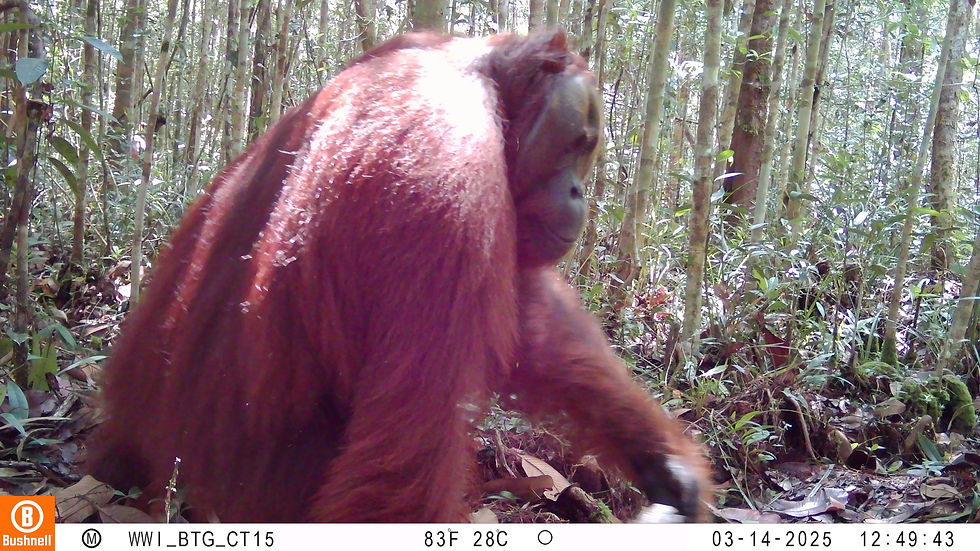
Known for their intelligence, these gentle giants are an iconic species of Southeast Asia's forests. They play a crucial role in their ecosystem as seed dispersers, helping maintain forest biodiversity. The Central Bornean orangutan population is estimated at just 30,000 individuals and continues to decline due to habitat loss, illegal logging, and poaching.
Forest Elephant
DEMOCRATIC REPUBLIC OF THE CONGO - MAI NDOMBE REDD+ PROJECT
Forest elephants are the smaller and more reclusive relatives of the larger savanna elephant. Before Wildlife Works’ conservation efforts, they had been scared away by logging companies and hadn’t been seen in the area in decades. Today, their populations have recovered and returned to this key habitat.
Bonobos:
DEMOCRATIC REPUBLIC OF THE CONGO - MAI NDOMBE REDD+ PROJECT
Bonobos are 98.7% related to humans, making them one of our closest relatives. Found only in the Democratic Republic of the Congo, their populations in the Mai Ndombe project area have rebounded since the project began.
Secretary Bird
KENYA - KASIGAU CORRIDOR REDD+ PROJECT

The secretary bird, a primarily ground-dwelling bird of the savannas, is known for it's intimidating hunting style of stomping on snakes.
Impala
KENYA - KASIGAU CORRIDOR REDD+ PROJECT

Impalas, with the "M" shaped arch on their rear side, are unfortunately known as the fast food of the savannas. These impressive antelopes can run up to 50mph to evade predators. When threatened or startled, they can perform spectacular leaps, jumping up to 10 feet high in the air.
Kudu
KENYA - KASIGAU CORRIDOR REDD+ PROJECT

Kudus are impressive antelopes of Africanan savannas, known for the male's massive spiraling horns. Each kudu has between 6 and 10 white vertical stripes along its body, which act as camouflage in the bushland. They can go long periods without drinking water, relying on moisture from the food they eat (leaves, fruits).
Lion
KENYA - KASIGAU CORRIDOR REDD+ PROJECT

In this camera trap image, a lioness stalks down a hill near a watering hole. See if you can also spot the elephant in this image!
Lions are apex predators, and perform the critical job of managing herbivore populations. Without lions, ecosystems become unbalanced, and unchecked populations of zebras, gazelles, and antelopes inevitably overgraze grasslands, leading to habitat degradation. By going after the weakest members of the herd (often those carrying parasites, disease, or genetic defects) lions help to maintain healthy, resilient populations and prevent the spread of disease.
Despite this importance, lion populations continue to dwindle globally due to poaching and habitat loss caused by human activities. Worldwide, there are only an estimated 30-40,000 mature lions left in Africa, and they are listed as Vulnerable to extinction on the IUCN.
At any given time, there are 15-30 lions in our project area.
Explore the projects behind these images and help protect the ecosystems where wildlife is returning. Buy verified Forest Carbon Credits.


