Valuing the Priceless: May 2026

Exciting news: driven largely by progress in protecting tropical forests, intentional forest destruction fell 14% in 2025 and reached its lowest level in over a decade, according to the World Resource Institute's latest report. However, escalating wildfires exacerbated by global warming consumed an area of forest roughly the size of Cuba, highlighting the growing climate risks facing forests worldwide.
How can companies help mitigate these climate risks? New research suggests that if companies use nature-based carbon credits, they could significantly help improve the chances of limiting warming to 2°C by 2030. In different modeling scenarios, researchers found that high-integrity nature-based credits could reduce mitigation costs, increase overall emissions reductions, and accelerate climate action across the corporate sector. Fighting climate change depends on us using our entire toolkit to make real progress now, especially to protect forests that are still standing.
Why We Must Protect Existing Forests First
For years, climate finance has prioritized planting new trees over protecting existing forests. But new research from Sweden reinforces what Indigenous Peoples and forest-dependent communities have long understood: old-growth forests are not replaceable.
The findings are striking:
Old-growth forests store 83% more carbon overall than managed forests.
They hold approximately 363 tonnes more CO2 per hectare than the managed forests replacing them.
Due to their immense networks of biodiversity, the soil in old-growth forests alone stores as much carbon as a managed forest stores in total.
The science is increasingly clear: conservation and restoration must work together, but protecting existing forests must come first.
New research from the Brazilian Amazon further underscores this point. While conservation policies have reduced deforestation, forest degradation continues to erode carbon stocks, biodiversity, and ecosystem services. Between 2003 and 2014, nearly 69% of net carbon losses in tropical forests were linked to degradation rather than outright forest clearing.
This is why Wildlife Works prioritizes long-term, community-led conservation strategies designed not only to prevent deforestation, but also to address the underlying drivers of forest degradation.
Wildlife Works in the News

Human–wildlife conflict remains one of the most significant threats to both wildlife and livelihoods across the Kenyan savannah.
At the Kasigau Corridor REDD+ Project, Wildlife Works partners with local communities to develop practical, locally led solutions that support coexistence between people and wildlife. We are proud to see one of these innovations featured recently by New Scientist: the Kasaine fence, developed by Simon Kasaine. The low-cost design uses wire and metal strips that create sound in the wind, discouraging elephants from entering farms.
The feature highlights how community-driven innovation can help reduce conflict, protect livelihoods, and support wildlife conservation simultaneously.
Wildlife Works at SF Climate Week
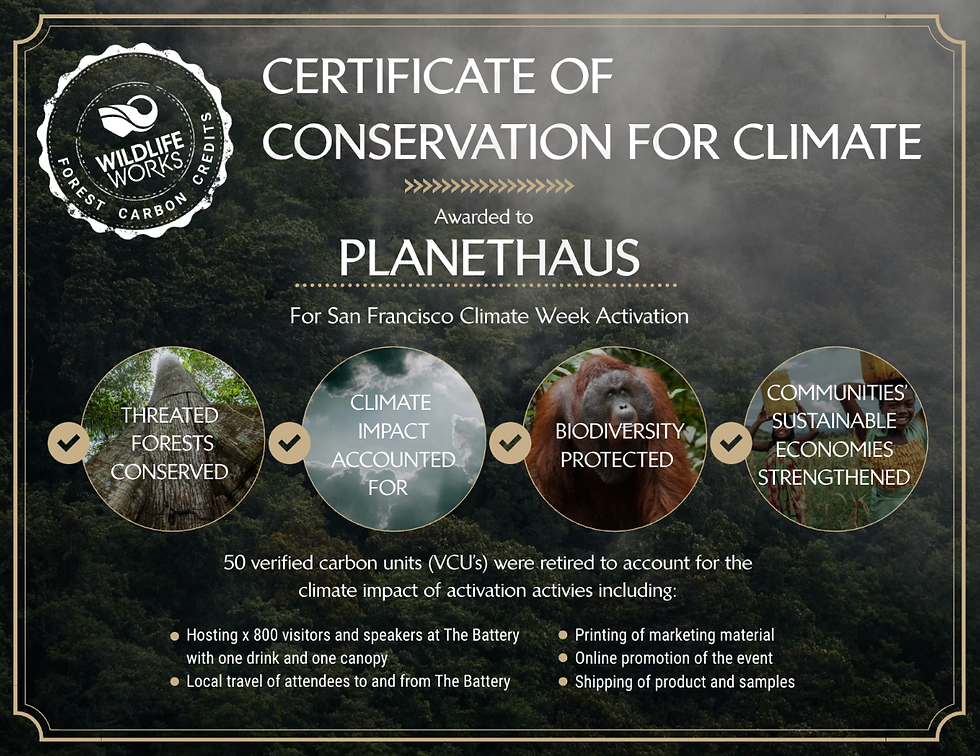
On this year’s Earth Day, Wildlife Works was proud to partner with PlanetHAUS and nearly 50 brands such as Dr. Bronner’s and Patagonia to showcase products and solutions available today that support a more sustainable economy. To extend their impact into global climate action, PlanetHAUS has funded community-led conservation through Wildlife Works Forest Carbon Credits at a level proportional to the unavoidable emissions associated with the activation.
Our Founder and President Mike Korchinsky also spoke at Stanford’s Natural Climate Solutions Initiative event titled ‘Better Together: Nature-Based Reductions & Removals.’ Alongside leaders from The Nature Conservancy, Carbon Direct, Rubicon Carbon and the Stanford Doerr School of Sustainability, the conversation focused on how reforestation and forest protection efforts must tackle the root causes of deforestation, and strategic mechanisms to navigate the voluntary carbon market.

Update: Wildlife Works is Officially a Public Benefit Corporation (PBC)
This is not a shift in who we are, but a formal recognition of who we have always been. Nearly three decades ago, Wildlife Works began as a conservation organization grounded in a deep commitment to protecting wildlife by creating opportunities for the communities who live alongside it. Whether we use carbon credits or other finance structures to protect nature with communities, becoming a PBC simply aligns our structure with that purpose.
Other News and Research We're Following
CALIFORNIA CONDORS RETURN TO YUROK ANCESTRAL LAND FOR THE FIRST TIME IN A CENTURY (Source: Mongabay)
RENEWABLE ENERGY HIT A RECORD HIGH IN 2025 (Source: Earth.org)
GOVERNMENTS NOT COMPLYING WITH UN DECLARATION ON INDIGENOUS RIGHTS (Source: Grist)
RAINFORESTS CAN BOUNCE BACK MUCH FASTER THAN THOUGHT, RESEARCHERS SAY (Source: NYT)
Market Updates
INTERNATIONAL AVIATION BODIES INFLUENCING THE VCM
As the voluntary market increasingly overlaps with other carbon markets (CORSIA, Article 6.4 PACM, etc.), the direction of the VCM is influenced by the politics and trends in those markets. ICAO, the international aviation body that oversees the CORSIA market, recently approved the Forest Carbon Partnership Facility and BioCarbon Fund Initiative for Sustainable Forest Landscapes standards for use under Phase I and is considering several standards for approval for Phase II. The outcomes of these decisions will directly shape the supply in the CORSIA market, which in turn will affect available supply in the VCM.
ICAO has delayed regarding approval of Zimbabwe’s national registry, which may be a signal of what is to come for other sovereign registries that seek to supply to the market. Meanwhile, the European Commission is weighing additional restrictions for EU airlines to abide by beyond CORSIA’s existing criteria for using credits to offset emissions. If the EU’s restrictions are unworkable, it could ultimately lead to a breakdown of the CORSIA market in general, with EU airlines instead having to face steeper compliance costs under the EU emissions trading system. Source: QCI
ARTICLE 6.4 DELAY
The Article 6.4 Methodological Expert Panel, which helps oversee the PACM international carbon trading mechanism, was supposed to publish several standards and tools last week which are relevant for large-scale activities like JREDD. However, these documents have been delayed, likely until after their next meeting in June. Of interest will be updated rules related to calculating the risks of reversals, establishing a minimum threshold of acceptable risks, addressing international leakage, among others. Several major market players in the nature-based solutions sector plan to advocate for rules that are both robust and which encourage these approaches, which are affordable, immediately feasible, and possible to achieve at large scales.
NEW COALITION TO BOOST INTEGRITY AND EFFECTIVENESS OF CARBON MARKETS
The European Union, Brazil, and China have launched a new international coalition to strengthen the integrity, transparency, and effectiveness of carbon markets worldwide. The initiative will promote high-quality carbon pricing systems, robust accounting standards, and credible offsets, reinforcing global cooperation and supporting delivery of the Paris Agreement climate goals. Source: European Commission
LIBERIA THREATENED WITH FUNDING LOSS IF IT FAILS TO SELL CARBON CREDITS
Liberia is reportedly facing pressure from the African Development Bank to approve forest carbon credit sales under the UN aviation scheme CORSIA, amid rising demand for eligible offsets. Critics warn the rushed policy could weaken community protections and undermine long-term forest revenues, highlighting tensions between climate finance, development goals, and local safeguards Source: QCI
INDONESIA UPDATES CARBON MARKET RULES
Indonesia has updated its forestry regulations to encourage more carbon projects in conservation areas and hunting parks, introducing new levies and business fees on carbon credit sales. The reforms aim to simplify project development and align with evolving laws and community needs, though questions remain about whether added costs will truly incentivize investment. This update comes alongside news that Indonesia’s deforestation surged 66% in 2025, reversing years of decline. Sources: QCI, Mongabay
Wildlife Works is Hiring
Interested in joining our team? View our open positions around the world here.
Subscribe to Our Email Newsletter
Want this newsletter delivered directly to your email inbox? Subscribe Here.

