Listening to a Mountain: What 15 Years of Bird Monitoring on Mount Kasigau Tell Us About Climate Change and Biodiversity Conservation at Kasigau Corridor REDD+ Project
By Mwangi Wambugu and Bernard Amakobe
Key Takeaways
15 years of bird monitoring on Mount Kasigau provide one of the longest-running datasets on tropical mountain birds in East Africa.
Most bird populations remained stable, suggesting that intact mountain forests can help buffer wildlife against climate change.
Birds are not responding to warming in the same way. While some species are moving upslope, others remain stable or show signs of decline, highlighting the complexity of climate adaptation.
Long-term biodiversity monitoring acts as an early warning system, helping conservationists detect ecological changes before declines become irreversible.
Protecting entire mountain ecosystems and elevational gradients will become increasingly important as species adjust to changing temperatures.
Community-supported conservation makes long-term science possible, generating the evidence needed to guide future conservation decisions.
From the surrounding plains of Tsavo, Mount Kasigau rises abruptly from the semi-arid landscape like an island in the sky. Cloaked in ancient forest and reaching over 1,600 metres above sea level, the mountain forms part of the globally important Eastern Arc biodiversity hotspot. For thousands of years, its cool, moist forests - along with other nearby mountains - have provided refuge for plants and animals found nowhere else on Earth.
Today, however, this majestic and isolated mountain is becoming something else - a natural laboratory for understanding how biodiversity responds to a changing climate.
For the past fifteen years, Wildlife Works has quietly maintained one of the longest-running bird monitoring programmes on an Eastern Arc mountain as part of their biodiversity monitoring efforts at Kasigau REDD+ Project. While conservation often celebrates dramatic discoveries, this project has been built on consistency, something less glamorous but equally important. Year after year, season after season, researchers have returned to the same locations, using the same methods, to ask a deceptively simple question:
How are Mount Kasigau's birds responding to environmental change?

The answers emerging from this long-term effort are beginning to reshape our understanding of tropical mountain ecosystems. They offer reasons for optimism, identify species that require closer attention, and reinforce the need for sustained biodiversity monitoring if conservation is to stay ahead of the challenges posed by climate change.
Mountains on the frontline of climate change
Across the globe, climate change is altering where species can survive. As temperatures rise, many plants and animals are gradually shifting towards cooler environments, moving either polewards or uphill. For mountain species, however, moving uphill is not an endless option. Eventually, they ran out of a mountain.
This phenomenon has become known as the “escalator to extinction.” Species confined to mountain tops may eventually find themselves with nowhere higher to go as suitable climatic conditions continue to shift upward.
Yet not all species respond in the same way. Some move quickly, while others remain surprisingly stable. Some even decline without shifting their ranges at all. Understanding these differences requires long-term monitoring that captures ecological change over many years rather than isolated snapshots.
Mount Kasigau provides an exceptional opportunity to study these dynamics.
Separated from the neighbouring Taita Hills by approximately fifty kilometres of hot, dry lowlands, the mountain functions as a biological “sky island.” Many forest-dependent species cannot easily disperse between these isolated habitats, making Mount Kasigau an ideal place to investigate how biodiversity responds to environmental change.

Building one of East Africa’s longest bird monitoring programmes
Since 2011, Wildlife Works' Kasigau Corridor REDD+ Project has monitored understory birds, which traditionally live in the lowest level of a forest, just above the ground, along Mount Kasigau’s elevational gradient using four permanent mist-netting stations located from approximately 858 metres to 1,547 metres above sea level.
Each monitoring session follows a standardised bird ringing protocol. Birds are safely captured, identified, measured, fitted with uniquely numbered rings where appropriate, and released unharmed. By repeating the same methods over many years, researchers can distinguish genuine ecological changes from short-term natural fluctuations.
To date, the programme spans more than fifteen years of monitoring across twenty-three sampling sessions, representing one of the most comprehensive datasets available for tropical montane birds in the Eastern Arc Mountains.
Long-term ecological datasets such as these are uncommon in tropical Africa. Their value increases every year because they allow researchers to detect gradual trends that would otherwise remain invisible.

More than counting birds
Early analyses of the Mount Kasigau dataset focused on understanding how bird communities varied across the mountain.
The findings showed that elevation strongly shapes understorey bird communities. Species richness, diversity, and community composition change predictably from the dry Acacia-Commiphora woodlands at lower elevations to the cool montane cloud forests higher up the mountain. Temperature and human disturbance also influence these communities, highlighting the importance of conserving intact forests across the entire elevational gradient.
These findings established an important ecological baseline. They showed what a relatively intact tropical mountain bird community looks like and provided a benchmark against which future environmental change could be measured.
The question then became even more interesting:
Were these communities beginning to change over time?
Encouraging news with important caveats
The latest analyses provide encouraging evidence that many Mount Kasigau bird populations have remained remarkably stable over the fifteen-year study period.
For conservation scientists, stable populations are good news.
Around the world, numerous long-term studies have documented widespread declines in bird populations associated with habitat loss, climate change, and other human pressures. Against this backdrop, the relative stability observed on Mount Kasigau suggests that intact tropical mountain forests can provide important refuge for biodiversity.
However, the story is more nuanced than simply declaring success.
Researchers identified two periods during which many species experienced marked declines, suggesting that even relatively intact ecosystems remain vulnerable to environmental shocks. While many populations subsequently recovered, these episodes remind us that conservation cannot become complacent.
The findings also indicate that not every species is responding in the same way. While many birds appear resilient, a small number, including species of conservation concern, show evidence of declining trends that warrant continued monitoring and targeted conservation attention.

Are the birds moving uphill?
Perhaps the most intriguing question emerging from the monitoring programme concerns elevation.
As temperatures continue rising globally, scientists have predicted that tropical mountain birds should gradually shift their distributions towards higher elevations to remain within their preferred climatic conditions.
To investigate this possibility, Wildlife Works researchers at the Kasigau Corridor REDD+ Project used the dataset to attempt to answer this question.
The emerging picture is fascinating!
Rather than all species shifting in the same direction, different species appear to be responding differently. Some show evidence consistent with gradual upslope movements, others remain relatively stable, while several exhibit complex changes that likely reflect interactions between climate, habitat quality, ecological competition, and species-specific biology.
This reinforces an increasingly important lesson from climate change research—that there is rarely a single response shared by an entire ecological community.
Understanding these individual species responses will become increasingly important as temperatures continue to rise.
Science that informs conservation
The greatest value of long-term monitoring lies not simply in producing scientific publications, but in improving conservation decisions.
Monitoring allows conservation practitioners to identify emerging threats before population declines become irreversible. It enables managers to evaluate whether conservation interventions are working and provides governments, donors, and local communities with robust evidence to guide future investments.
The Mount Kasigau programme demonstrates how science can support practical conservation management.
Rather than reacting only after biodiversity has declined, long-term monitoring provides an early warning system that helps conservation stay proactive rather than reactive.

Looking ahead
While the findings from Mount Kasigau provide cautious optimism, they also emphasise the importance of continued investment in biodiversity monitoring.
Several priorities emerge.
First, long-term monitoring programmes should be strengthened rather than treated as short-term research projects. Ecological change often unfolds over decades, meaning today's baseline becomes tomorrow's evidence.
Second, conserving complete elevational gradients will become increasingly important as species adjust their distributions under changing climatic conditions.
Third, reducing local pressures such as forest degradation, unsustainable resource extraction, and uncontrolled fires can improve ecosystem resilience while global efforts to reduce greenhouse gas emissions continue.
Finally, conservation succeeds best when local communities remain active partners. The long-term protection of Mount Kasigau’s forests depends not only on ecological understanding but also on creating sustainable livelihoods that reinforce the value of keeping forests intact.
Listening to what nature is telling us
Perhaps the greatest lesson from Mount Kasigau is the value of patience.
Meaningful ecological change rarely reveals itself within a year or two. It emerges gradually through sustained observation, careful analysis, and long-term commitment.
For fifteen years, Wildlife Works has returned to the same mountain, walked the same forest trails, and monitored the same bird communities. That quiet consistency is now yielding insights that extend well beyond Mount Kasigau itself.
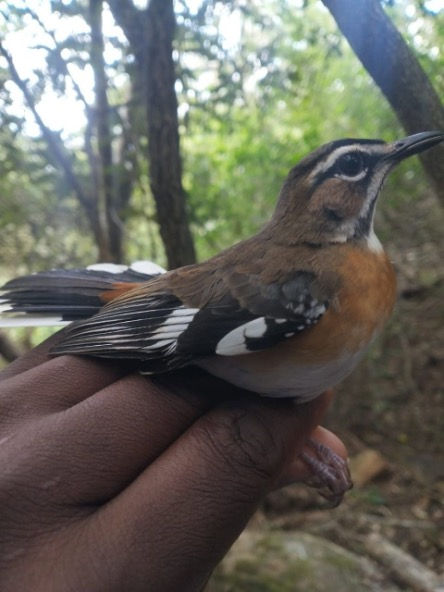
As climate change accelerates across Africa, long-term ecological monitoring will become one of conservation’s most powerful tools. It helps us distinguish temporary fluctuations from genuine trends, identify species requiring urgent attention, and evaluate whether our conservation efforts are achieving their intended outcomes.
The birds of Mount Kasigau are telling us an important story. They remind us that nature and biodiversity is remarkably resilient when ecosystems remain intact, but they also caution that resilience has limits.
By continuing to listen and acting on what we learn, we can ensure that these mountain forests remain refuges for biodiversity for generations to come.
Photos and captions.


FAQ
How does climate change affect birds?
As temperatures rise, many bird species shift their ranges toward cooler habitats, often moving to higher elevations or toward the poles. However, long-term monitoring on Mount Kasigau shows that species respond differently. Some birds appear to be moving uphill, while others remain stable or decline, demonstrating that climate adaptation is more complex than previously thought.
Why is long-term bird monitoring important?
Many ecological changes occur gradually over decades and cannot be detected through short-term studies. Long-term monitoring helps scientists identify population trends, measure the impacts of climate change, evaluate whether conservation efforts are working, and detect emerging threats before they become irreversible.
What is the “escalator to extinction”?
The “escalator to extinction” describes what can happen to mountain species as temperatures rise. Species move uphill to stay within suitable climates, but mountains have finite elevations. Eventually, some species may run out of suitable habitat if warming continues.
Why are mountain forests important for biodiversity?
Mountain forests often contain unique climates and habitats that support species found nowhere else. Mount Kasigau is part of the Eastern Arc biodiversity hotspot, one of the world’s most important regions for endemic plants and animals. These forests also serve as climate refuges that help species survive changing environmental conditions.
What is bird ringing, and why do scientists use it?
Bird ringing (also called bird banding) involves safely capturing birds, recording measurements, fitting them with a uniquely numbered lightweight ring, and releasing them unharmed. If a bird is recaptured later, researchers can learn how long it has lived, whether it has moved to a different elevation, and how populations are changing over time.
What is mist netting and is it safe for birds?
Mist netting is a method used by scientists and wildlife professionals to capture wild birds safely. They use very fine, almost invisible nylon or polyester mesh stretched between two poles, much like a volleyball net. When a bird flies into the net, it falls into a loose pocket created by the mesh. It isn’t tangled tightly like a fishing net; the design is intended to safely cradle the bird until researchers arrive. Only trained bird ringers (banders) remove birds from the nets. They use gentle techniques to free wings, legs, and the head without causing injury.
Can intact forests help wildlife adapt to climate change?
Growing evidence suggests they can. The Mount Kasigau study found that many bird populations have remained stable over the past fifteen years, indicating that healthy, protected forests can provide important refuges that help wildlife withstand climate pressures.
Are all bird species moving uphill because of climate change?
No. The Mount Kasigau monitoring programme found that species are responding differently. Some show evidence of upslope movement, others have remained in similar locations, and some exhibit more complex changes influenced by habitat quality, competition, and species-specific ecology.
Why does biodiversity monitoring matter for conservation?
Monitoring provides the evidence needed to make better conservation decisions. It helps identify vulnerable species, measure whether conservation investments are delivering results, guide habitat management, and prioritize actions before biodiversity declines become severe.
How does community-led conservation support scientific research?
Long-term ecological research depends on long-term protection of habitats. At Mount Kasigau, community-supported conservation has helped keep forests intact, making it possible to monitor wildlife consistently over fifteen years. This partnership between local communities and conservation practitioners generates scientific evidence that benefits both biodiversity and future conservation planning.
Why does long-term biodiversity monitoring matter for companies investing in nature?
Long-term monitoring provides independent scientific evidence that conservation outcomes are being maintained over time. Rather than relying on one-time biodiversity surveys, continuous monitoring helps demonstrate ecosystem health, identify emerging risks, and show whether investments in forest conservation are delivering lasting climate and biodiversity benefits. This kind of evidence is becoming increasingly important as companies seek high-quality, science-backed nature investments.

